
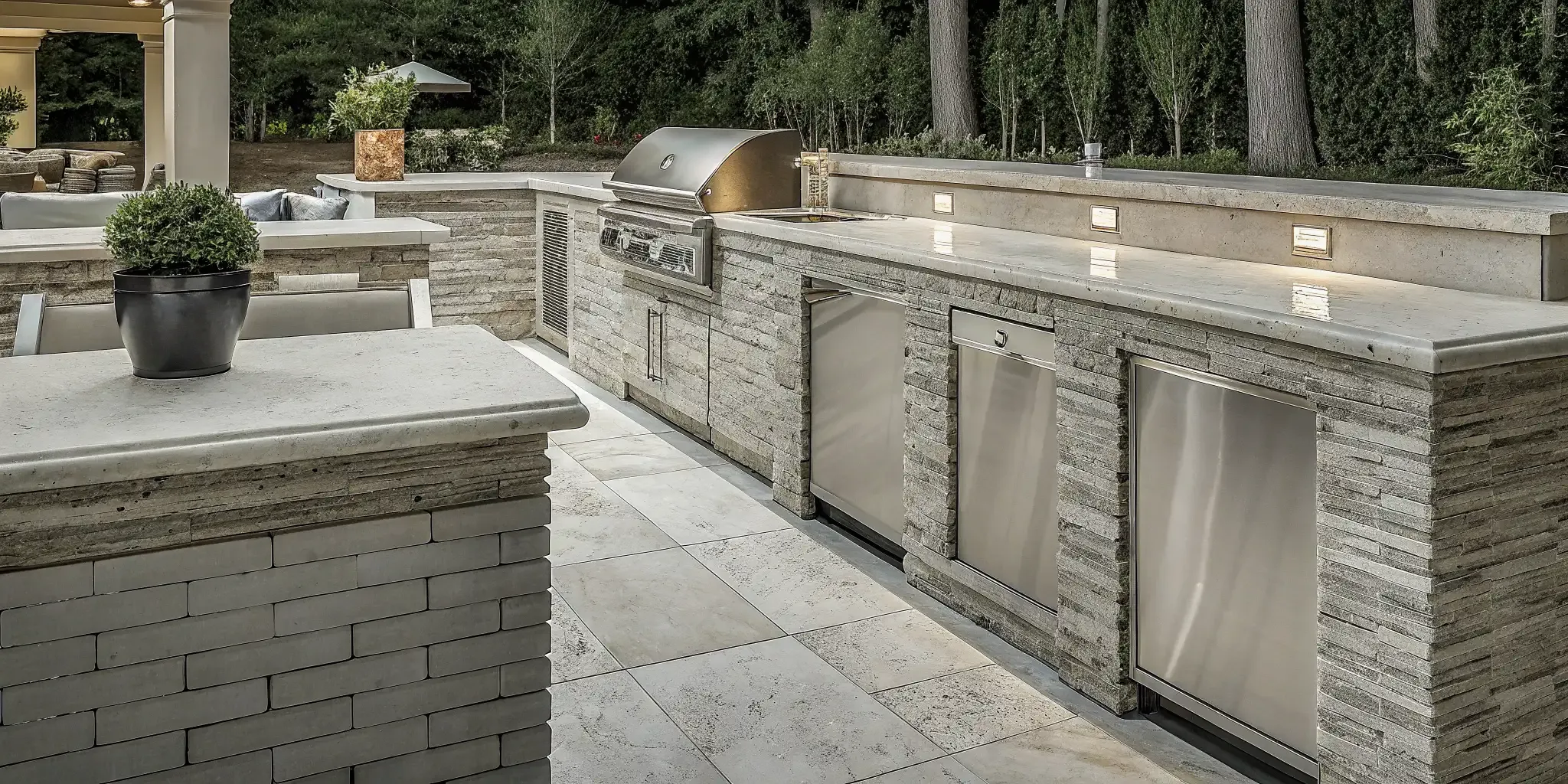
An outdoor kitchen is more than a grill and a counter. In Delaware and Pennsylvania, the final investment reflects how the space is designed, built, connected to the home, and prepared for changing weather. A thoughtful budget starts with the experience you want to create, then accounts for the materials and infrastructure needed to make it last.
An outdoor kitchen cost typically falls between $5,000 and $50,000 for a custom-built setup, with national averages commonly reported around $13,000 to $17,000. Premium projects can exceed that range when they include substantial masonry, high-end appliances, custom stonework, utilities, lighting, or complex installation. Your design, material selections, and site conditions ultimately determine the appropriate investment.
For homeowners in Wilmington, Greenville, the Main Line, and Chester County. The most useful estimate comes from examining each part of the project rather than relying on a single national figure. The structure, countertops, appliances, utilities, and installation complexity all play a distinct role in the finished result.
What Factors Influence the Cost of an Outdoor Kitchen?
An outdoor kitchen is a coordinated construction project, not simply a grill placed beside a patio. The final investment reflects the footprint, structural system, finish materials, appliances, utility connections, and installation conditions. A useful early estimate should account for the entire design rather than focusing on the most visible feature.
Size and structural framing
The larger the island or kitchen run, the more framing, cladding, countertop area, storage, and labor it requires. Research from Backyard Discovery places structural framing at approximately $250 to $670 per linear foot, depending on the materials used. A compact straight run may be efficient, while an L-shaped or U-shaped layout creates more workspace and seating opportunities but adds corners, support, and finishing work.
Framing materials also influence both price and character. Stone can create a substantial, architectural appearance, while stucco and wood may support a different design language and budget. The right choice depends on the home's architecture, exposure to weather, maintenance expectations, and the surrounding hardscape. DiSabatino's handcrafted hardscaping work can help coordinate those material decisions with the larger outdoor environment.
Countertops and finish materials
Countertops must withstand sun, moisture, temperature changes, food preparation, and regular cleaning. Granite is often selected for its durable, substantial finish. Tile can offer visual flexibility, but grout requires thoughtful detailing and maintenance. Concrete can be shaped and finished for a highly customized look, although its fabrication and reinforcement requirements affect the estimate.
Installed outdoor countertop pricing is commonly cited at $50 to $200 per square foot. A typical 10- to 12-foot island uses about 15 to 20 square feet of countertop. Creating a countertop allowance of roughly $750 to $4,000 before other components are included. The material, edge profile, cutouts, support requirements, and installation access all affect where a project falls within that range.
Appliances, utilities, and installation complexity
Appliance selection can shift the budget substantially. A built-in grill may be the starting point, while an outdoor refrigerator, sink, side burner, storage drawers, smoker, or pizza oven adds equipment, connections, and coordination. Plumbing, gas, electrical work, ventilation, drainage, and required permits may also be necessary depending on the design and site.
Labor varies by region because wages, material availability, transportation, site access, and local requirements are not uniform. BBQGuys notes that an equivalent project can cost more in one market than another because of labor and materials. The overall cost therefore depends on the structural materials, appliances, countertop selection, and installation complexity, as well as the conditions specific to the property.
Outdoor Kitchen Cost Ranges: From Basic to Premium
Outdoor kitchen cost varies widely because a compact grilling station and a fully integrated entertaining space are fundamentally different projects. National estimates place most custom outdoor kitchens between $5,000 and $50,000, with an average of approximately $13,000 to $17,000. BBQGuys reports a typical range of about $6,000 to $30,000, while luxury installations can extend beyond $30,000. These figures are useful benchmarks, not fixed bids.
| Tier | Typical investment | Common scope | Best suited for |
|---|---|---|---|
| Basic | $5,000-$15,000 | Island kit, entry-level grill, basic countertops, and limited storage | Homeowners seeking a dedicated grilling area with a focused footprint |
| Mid-Range | $15,000-$35,000 | Custom stone construction, premium grill and refrigerator, granite countertops, and expanded storage | Frequent hosts who want cooking, prep, and serving functions in one space |
| Premium | $35,000-$75,000+ | Full outdoor kitchen, pizza oven, custom stonework, luxury appliances, integrated lighting, and professional design-build | Homeowners creating a cohesive outdoor living and entertaining environment |
The tiers are directional. A basic island kit may start near $2,000 before site work and installation, according to BBQGuys cost research, while a custom luxury kitchen can approach $100,000 when high-end materials, appliances, and construction requirements are included. A pizza oven, additional refrigeration, gas and electrical work, covered areas, drainage, or complex masonry can move a project into a higher tier quickly.
Geography also affects the final number. BBQGuys notes that the same project may cost approximately $11,700 in Texas but $19,600 in Los Angeles because labor and material costs differ by market. The Delaware and Pennsylvania area has its own labor conditions, permitting requirements, material availability, site access challenges, and seasonal construction considerations. A national average therefore cannot replace a local assessment of the property and the intended design.
For inspiration before setting a budget, explore these luxury outdoor kitchen design ideas. The most useful starting point is to define how you plan to cook and entertain. Then align the appliance package, counter space, finishes, utilities, and surrounding hardscape with that use.
Breaking Down Outdoor Kitchen Costs by Component
A reliable budget separates the visible features from the infrastructure that makes an outdoor kitchen safe, durable, and comfortable to use. The following cost categories help clarify where an investment goes. Actual pricing depends on the design, materials, site conditions, utility access, and level of finish.
- Structural base and framing. The island or cabinet structure establishes the footprint and supports the countertops and appliances. Structural costs commonly range from $250 to $670 per linear foot, depending on materials and construction method. A 10-foot island at $400 per linear foot, for example, would represent approximately $4,000 for the base alone, before countertops, appliances, or utility work. Backyard Discovery's cost breakdown provides the underlying framing and countertop ranges.
- Countertops. Outdoor-rated countertop materials typically cost $50 to $200 per square foot installed. A 10-to-12-foot island generally requires about 15 to 20 square feet of surface, placing this line item around $750 to $4,000. The right selection balances appearance, maintenance, heat resistance, and exposure to seasonal weather. Natural stone may be appropriate for a refined design, but the material should be evaluated for the specific installation and local conditions.
- Appliances. The cooking and entertaining program has a direct effect on the budget. Built-in grills can range from approximately $1,300 to $4,300 or more, depending on size and features. Outdoor refrigerators commonly run from $800 to $3,000, while pizza ovens may add approximately $2,000 to $8,000. Easton Outdoors' pricing guide illustrates how grill upgrades and specialty cooking equipment can move a project beyond its initial allowance.
- Cabinetry and storage. Weather-resistant drawers, doors, trash storage, shelving, and serving areas add function beyond the grill itself. Cabinet construction should be selected for outdoor exposure, not simply adapted from an interior kitchen. More storage, larger runs, and premium finishes increase the cost, but they can also reduce clutter and make the space easier to use.
- Plumbing and gas lines. A sink, beverage station, natural-gas connection, or propane system requires planned utility routing. The cost depends on the distance to existing connections, trenching, shutoffs, drainage, and whether the property needs new infrastructure. These elements are best coordinated with the island design rather than added after the structure is complete.
- Electrical work and lighting. Dedicated circuits may be needed for refrigeration, ignition systems, outlets, heaters, or other equipment. Task and ambient lighting add safety and extend evening use. A coordinated lighting plan can integrate the kitchen with surrounding outdoor living areas and should account for weather exposure and proper installation.
- Permits and project coordination. Permit requirements, inspections, gas regulations, electrical codes, and local building rules vary by municipality. Professional contractors must account for these requirements before construction, along with site preparation and installation labor. That planning is why two kitchens with similar appliances can have very different total budgets. BBQGuys notes that labor and material costs can vary substantially by location, while its estimates range from basic island kits near $2,000 to luxury projects approaching $100,000. Use component pricing as a planning framework, not a substitute for a site-specific design and proposal.
Does an Outdoor Kitchen Increase Home Value?
A well-designed outdoor kitchen can contribute to both a property's appeal and its long-term value, especially when it functions as a true extension of the home. In the Delaware Valley, outdoor living spaces are among the features many buyers actively seek because they create a dedicated setting for dining, entertaining, and everyday relaxation. The strongest value comes from thoughtful design, durable materials, and a layout that feels integrated with the landscape and architecture rather than added as an afterthought.
Value depends on design quality and usability
Industry assessments cited by the National Kitchen and Bath Association suggest that an outdoor kitchen may increase property value by approximately 10% to 20%. That range is not a guarantee, and the result depends on the neighborhood, overall project quality, and how well the space serves the way homeowners live. A carefully planned kitchen with appropriate circulation, comfortable seating, reliable appliances, and weather-conscious materials is more likely to feel like meaningful living space to a future buyer.
Cost should therefore be evaluated alongside function. Structural materials, appliance quality, countertop selection, and installation complexity all influence the investment. Spending more on a feature that improves durability and daily use can make more sense than adding expensive components that do not support the way the household entertains.
How much return can homeowners expect?
A report published by Grillio estimates an approximately 71% return on investment for an outdoor kitchen. As with any remodeling statistic, that figure should be treated as a planning reference rather than a promise at resale. Market timing, craftsmanship, maintenance, and the surrounding property all affect the return. A premium outdoor kitchen can still deliver value before a sale by making the home more enjoyable for years.
For a broader look at the lifestyle and entertaining advantages, review these benefits of outdoor kitchens. When the kitchen is designed as part of a cohesive outdoor environment, it can strengthen the property's presentation and help buyers envision how they would use the space.
Plan for lasting value
The best investment is not necessarily the largest kitchen. It is the one proportioned to the property, connected naturally to existing outdoor rooms, and built for the region's seasons. A consultative design-build process helps align the outdoor kitchen cost with durable performance, visual continuity, and the features that matter most to the household and local market.
Choosing the Right Outdoor Kitchen Builder in Delaware and Pennsylvania
An outdoor kitchen is more than a collection of appliances. It may involve masonry, gas or electrical connections, drainage, grading, lighting, weather-resistant materials, and a carefully coordinated relationship with the existing home. The builder you choose should be equipped to manage the complete environment, not simply assemble cabinets and install a grill.
Look for experience with the local conditions
Delaware and Pennsylvania properties bring specific considerations that can affect long-term performance. Freeze-thaw cycles, heavy rainfall, changing soil conditions, and regional weather patterns influence site preparation, foundations, drainage, material selection, and the way components are protected. A local contractor is more likely to understand how climate and soil affect an outdoor kitchen before construction begins.
That regional knowledge matters when comparing an outdoor kitchen cost estimate. A proposal that appears lower may not account for the grading, drainage, structural support, or weather-resistant construction needed for a durable installation. Ask prospective builders how they evaluate the site and which materials they recommend for local exposure, rather than comparing line items in isolation.
Choose an integrated design-build team
Complex outdoor living projects move more smoothly when design, construction, masonry, and installation are coordinated by one team. An integrated design-build firm can resolve practical details early, including appliance placement, countertop dimensions. Utility routes, seating areas, transitions to the home, and connections to existing patios or landscape features.
This approach also gives you a single point of accountability. Instead of coordinating a designer, mason, electrician, plumber, and separate installer, you have one team responsible for communication, sequencing, craftsmanship, and the finished result. That continuity is particularly valuable when the kitchen is part of a larger outdoor renovation.
Confirm permits, codes, and project responsibility
Before signing a contract, ask who handles permits and verifies applicable building, electrical, gas, and zoning requirements. Permits and codes are not administrative details to leave until the end. They help ensure that the work is approved, safely installed, and properly documented. Your builder should explain which approvals apply to your property and how inspections fit into the schedule.
DiSabatino brings more than 30 years of experience serving homeowners across Delaware, Pennsylvania, Maryland, and New Jersey. Its custom design-build process combines architectural planning, masonry, hardscape construction, and installation under one coordinated team. Explore its professional outdoor kitchen installation services and review how handcrafted hardscaping can support a cohesive, lasting outdoor setting.
Frequently Asked Questions
How much does a typical outdoor kitchen cost?
Most outdoor kitchens fall between $5,000 and $50,000, while commonly reported averages range from $13,000 to $17,000. A custom project in Delaware or Pennsylvania may exceed those figures when it includes premium appliances, substantial masonry, utilities, shelter, lighting, or complex site work. The right budget depends on the complete design rather than the grill alone.
What is the cost per linear foot for an outdoor kitchen structure?
Structure framing commonly ranges from $250 to $670 per linear foot, depending on the materials and construction approach. This figure covers the built form of the kitchen, not necessarily every appliance, countertop, utility connection, or finishing detail. A designer can help compare the cost and longevity of masonry, manufactured systems, and other appropriate materials.
How much should I budget for outdoor kitchen countertops?
Installed outdoor countertops generally range from $50 to $200 per square foot. A typical island requiring 15 to 20 square feet of counter space may therefore represent roughly $750 to $4,000 of the project budget. Material selection should account for appearance, weather exposure, maintenance, and compatibility with the structure.
What factors influence the final cost of an outdoor kitchen?
The largest variables are structural materials, appliance selection, countertop material, installation complexity, utility connections, drainage, site access, and added features. The relationship between the kitchen and the surrounding patio, walls, lighting, and landscape can also affect the scope. Coordinating these decisions early helps prevent expensive changes during construction.
Does an outdoor kitchen increase home value?
An outdoor kitchen can strengthen a property's appeal, but the financial return varies by location, design quality, workmanship, and how well the improvement fits the home. It is best evaluated as part of a complete outdoor living plan that improves how the property functions, not as a guaranteed resale formula.
Schedule Your Outdoor Kitchen Consultation
A thoughtful consultation can help you align the outdoor kitchen's design, materials, appliances, and installation with how you want to use your property. DiSabatino Landscaping brings an integrated design-build perspective to custom outdoor living projects in Delaware and Pennsylvania. To discuss your goals and next steps, call (302) 764-0408 to schedule a consultation for your custom outdoor kitchen.