
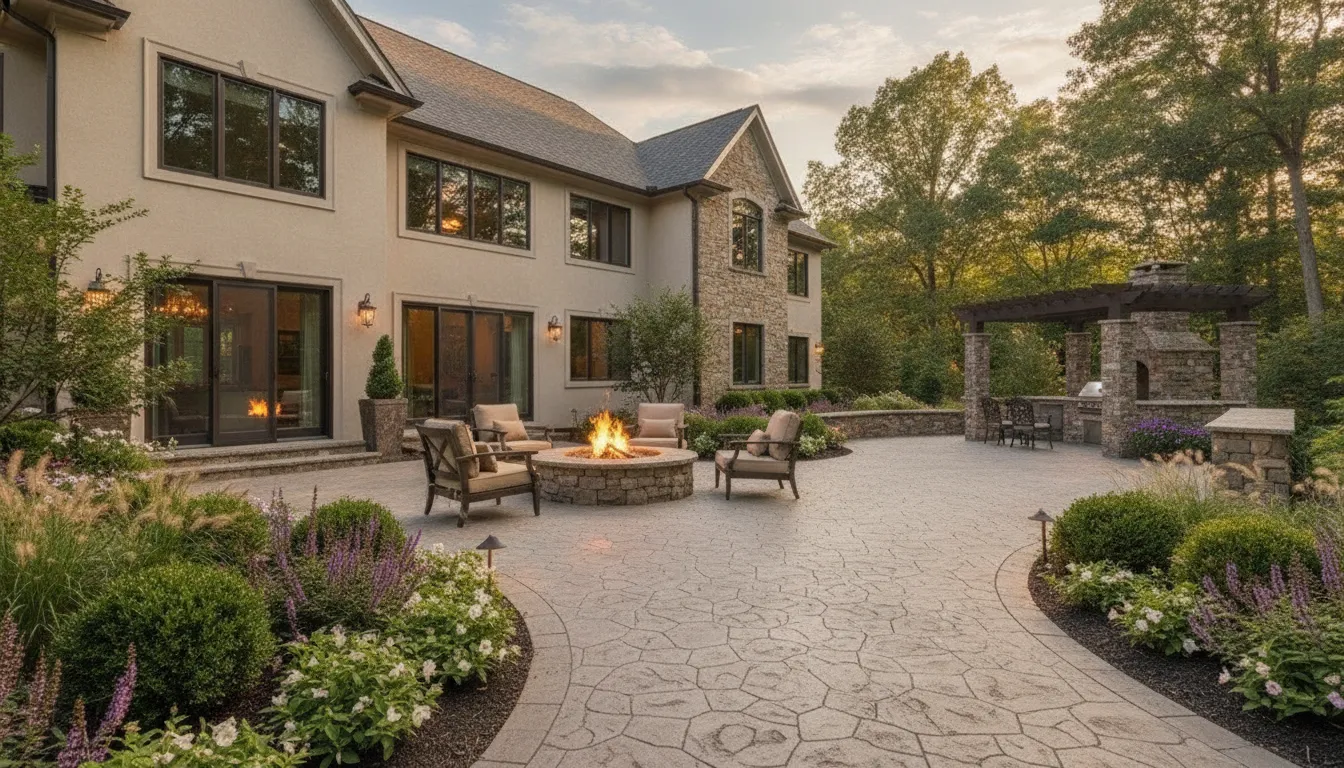
Choosing stamped concrete contractors is a design and construction decision, not simply a search for the lowest estimate. A driveway, patio, or walkway must be prepared for its site, proportioned to the home, finished with care, and protected through appropriate sealing and maintenance. The visible pattern matters, but the work below and around it determines how the project performs.
Explore DiSabatino's decorative stamped concrete expertise
The best stamped concrete contractors show comparable completed work, explain site preparation in plain language, and provide a detailed written scope. They coordinate pattern, color, drainage, transitions, sealing, warranty terms, and long-term care so the finished concrete supports the larger landscape design.
Use the questions below to compare proposals on substance rather than surface appearance. A strong contractor should welcome a thoughtful review of the property and help you understand what is included before construction begins.
What Should You Look For in Stamped Concrete Contractors?
Look for a contractor who combines relevant craftsmanship with disciplined project management. A polished portfolio is useful, but it is only one part of the decision. You also need evidence that the team can evaluate your property, manage water and grade, coordinate adjacent work, and remain accountable after the concrete is placed.
When comparing stamped concrete contractors, prioritize relevant installed work, an in-person site review, a detailed scope, clear communication, and written aftercare terms. These indicators reveal how a contractor manages the complete project, not just the decorative surface.
Review comparable completed work
Ask to see driveways, patios, walkways, or entertaining areas that resemble your project. Study the pattern scale, border treatment, color variation, edge work, transitions, and relationship to planting beds or masonry. Close-up images can hide uneven joints or awkward transitions, so ask for wider views that show the concrete in context. Ask which portions of each project the contractor completed and whether references are available for comparable work.
Expect a site visit and written scope
A serious proposal should follow an in-person review, not rely only on photographs or rough measurements. The contractor should discuss intended use, access, existing grade, drainage, adjacent materials, and design direction. The written scope should identify preparation, demolition, reinforcement, concrete placement, coloring, stamping, joints, curing, sealing, cleanup, exclusions, allowances, schedule assumptions, and change-order procedures.
Evaluate communication and accountability
Before signing, confirm who will guide design decisions, manage the site, answer questions, and coordinate other trades. A design-build team can provide a single point of accountability when concrete must work alongside landscaping, masonry, lighting, or an outdoor living area. DiSabatino's design-build process explains how a project can move from consultation and site assessment through planning, construction, and final walkthrough.
Use this checklist when comparing proposals:
- Relevant examples: Completed work with similar use, scale, and finish.
- Site review: An in-person evaluation of grade, drainage, access, and existing conditions.
- Detailed scope: Clear inclusions, exclusions, materials, sequencing, and change procedures.
- Accountability: A named project contact and a reliable communication plan.
- Aftercare: Written warranty terms and maintenance guidance that match the finish.
For a premium property, the right comparison is not just contractor versus contractor. It is a comparison of planning discipline, design judgment, and long-term responsibility.
How Does Installation Quality Affect a Stamped Concrete Project?
Installation quality controls far more than the finished impression. Grading, drainage, base preparation, reinforcement, joint layout, concrete placement, and finishing all influence how a stamped surface responds. Curing matters too. The surface must withstand foot traffic, vehicles, moisture, and seasonal temperature changes. A convincing pattern cannot compensate for a poorly prepared site.
Installation quality affects durability, drainage, appearance, and maintenance. A responsible contractor evaluates the site, prepares a stable base, plans joints and runoff. And controls placement, stamping, curing, and sealing instead of applying one standard method to every property.
Ask each contractor to explain the work that happens before the concrete arrives. The answer should address the existing surface, soil and drainage conditions, required excavation, base or subgrade preparation, reinforcement, forms, and the planned location of control joints. The exact assembly depends on the site and intended use. A responsible contractor should avoid promising that one standard section works for every property.
- Assess the site: Confirm access, grade, drainage paths, adjacent structures, and intended loads.
- Prepare the foundation: Remove unsuitable material and establish a stable, properly graded base.
- Plan water movement: Direct runoff away from the slab, structures, and vulnerable planting areas.
- Coordinate reinforcement and joints: Place them according to the design, site conditions, and expected movement.
- Place and finish carefully: Maintain consistent color, timing, pattern alignment, edges, and surface texture.
- Cure and protect: Follow the selected concrete system's curing and sealing requirements before regular use.
Drainage deserves particular attention on Delaware Valley properties. Water can collect beside a foundation, cross a walkway, or remain on a patio. These conditions can create functional and maintenance problems, even when the concrete looks attractive on day one. Ask where runoff will go and how the finished elevation will meet steps, doors, lawns, planting beds, and existing hardscape.
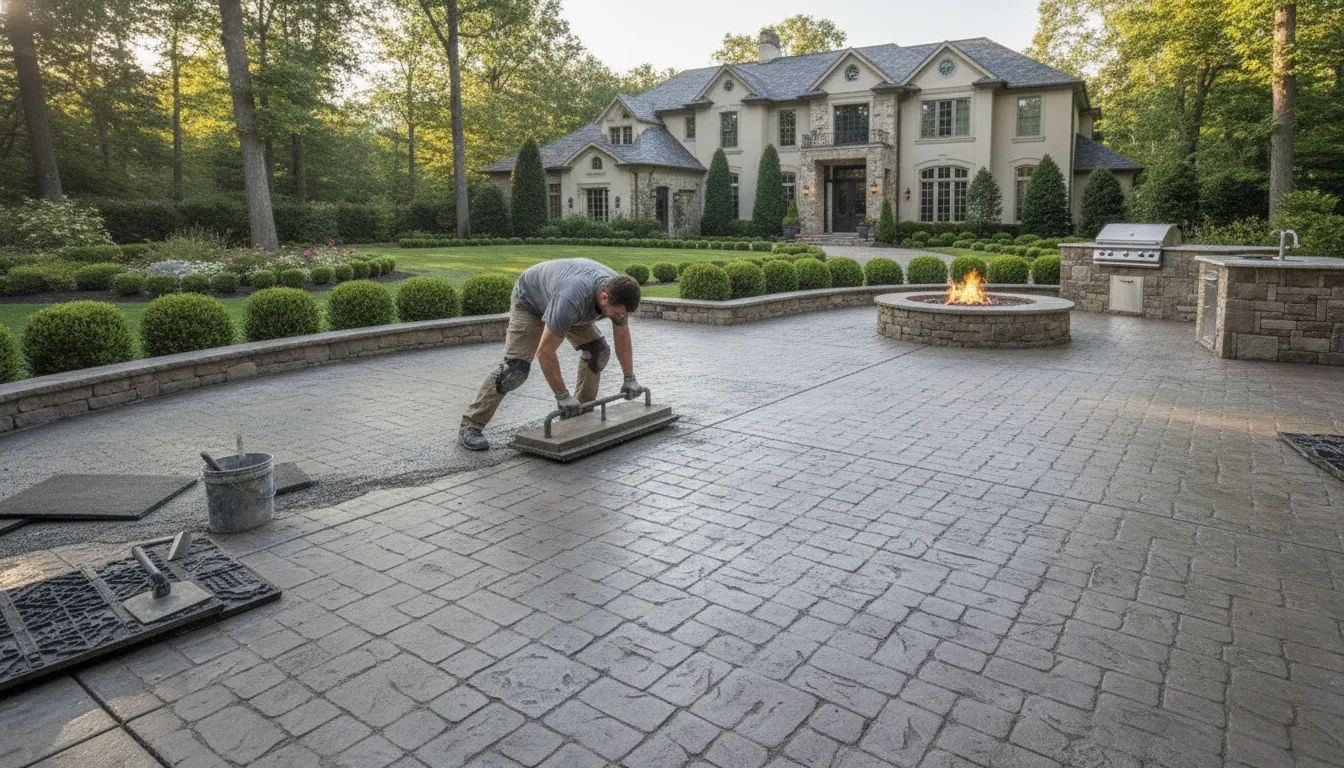
Construction also requires timing and coordination. Color hardener, release materials, stamping, finishing, and cleanup must be handled in the right sequence. Weather, crew readiness, access, and the size of the pour can affect that sequence. Ask how the contractor manages interruptions, protects adjacent surfaces, and communicates schedule changes.
Which Patterns, Colors, and Details Fit Your Property?
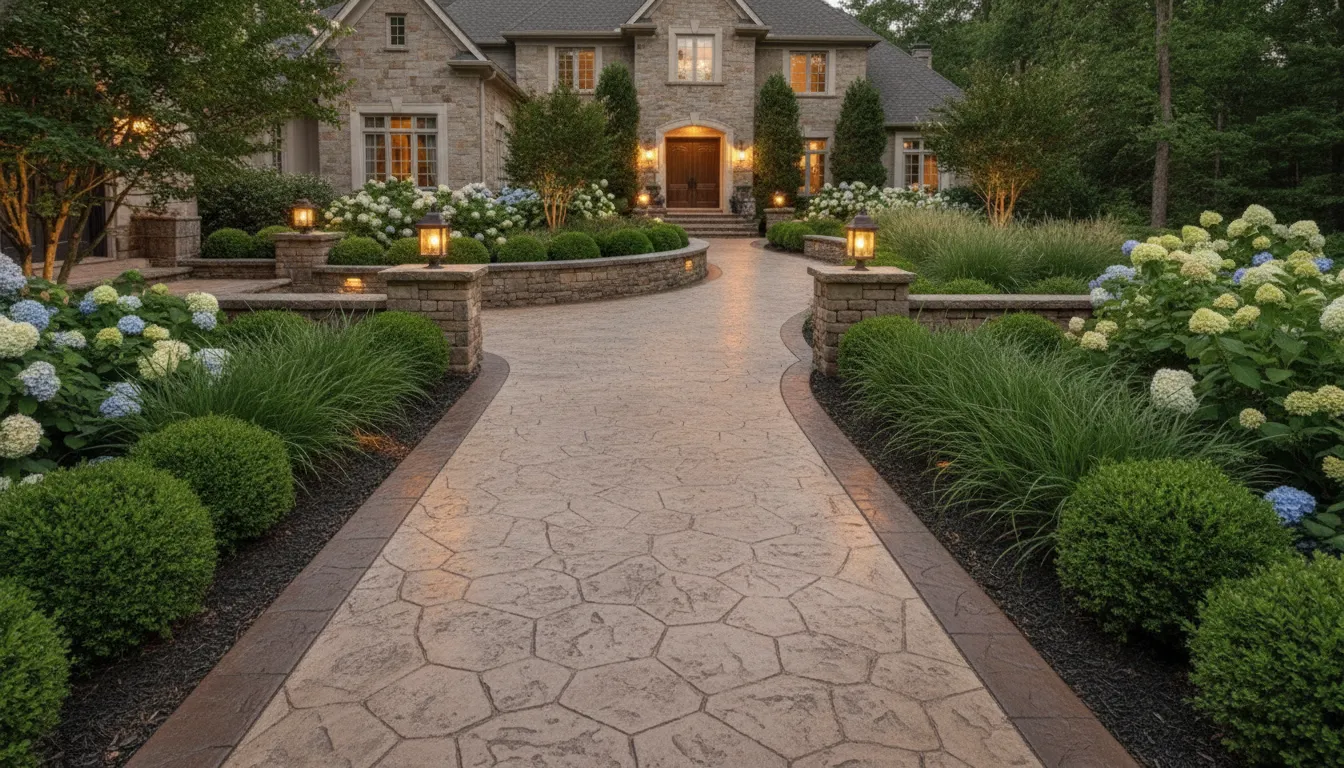
The most successful stamped concrete design responds to the architecture and landscape instead of imitating a material without context. Pattern, color, border, joint placement, and scale should work together. A design that feels appropriate on a large terrace may look busy on a narrow walkway. A strong border can define a driveway or connect outdoor rooms.
The right pattern and color reflect the home's architecture, existing masonry, planting, and the scale of the space. Review samples in natural light, study installed examples, and plan edges and transitions before selecting a finish.
Start with the property's existing character
Consider the home's roof, siding, stone, brick, trim, windows, and surrounding planting. Historic or traditional homes may benefit from restrained stone or brick references. A contemporary property may call for a simpler pattern, controlled color variation, and clean transitions. The goal is visual coherence, not a surface that competes with the architecture.
Compare samples in the right setting
Review pattern and color samples in natural light, and ask how the finish changes when it is wet, shaded, or viewed from a distance. Colors can appear different beside brick, natural stone, mulch, and lawn. If possible, study installed examples rather than relying only on small sample boards. Discuss how much variation is intentional and how the contractor will maintain a natural appearance across the entire pour.
Plan transitions and proportions
A stamped surface rarely exists alone. It may meet a front entry, garage apron, retaining wall, pool area, outdoor kitchen, or planting bed. Borders, steps, seat walls, and lighting should be considered before installation. DiSabatino's handcrafted hardscaping services show how paving, walls, walkways, and outdoor living elements can be planned as part of a connected landscape. Its architectural design services also illustrate why proportion and site context should be considered before construction.
Be cautious about choosing a pattern only because it is popular. Ask whether the repeat will be visually comfortable at the size of your space. Consider whether the pattern can follow the geometry of the walkway or patio. Also ask how edges will be resolved. Good design decisions are specific to the home, the site, and the way the family will use the space.
| Decision area | Questions to ask | What a strong answer includes |
|---|---|---|
| Pattern and scale | Will the repeat suit the space? | Installed examples, proportion guidance, and a plan for edges. |
| Color and variation | How will the finish relate to the home? | Samples viewed in daylight and a clear approach to variation. |
| Transitions | How will concrete meet other features? | Details for steps, walls, doors, planting, and existing hardscape. |
What Should You Ask About Sealing and Long-Term Care?
Sealing helps protect the appearance and surface of stamped concrete, but it is not a substitute for sound installation. The correct sealer, preparation, application conditions, and maintenance plan depend on the finish, exposure, use, and product system. Ask what product is proposed, how the surface will be prepared, when it will be applied, and how the contractor will address future maintenance.
Ask about the sealer, surface preparation, application conditions, care instructions, and warranty terms. A useful maintenance plan explains cleaning, spill response, drainage checks, edge protection, and how future maintenance decisions will be made.
Request care instructions in writing. They should explain how to remove leaves and debris, which cleaners are appropriate, how to respond to spills, and what practices could damage the finish. Ask how the surface should be evaluated over time and whether resealing is recommended based on visible wear or a stated maintenance interval. Avoid accepting a universal promise that every project should be resealed on the same schedule.
Clarify the warranty separately from routine care. A warranty should identify the covered work, duration, exclusions, owner responsibilities, and process for reporting a concern. It should also explain how changes, chemical exposure, deicing products, settlement, drainage, or ordinary wear are treated. A clear warranty is more useful than a broad verbal assurance.
After installation, simple habits can help preserve the finish:
- Keep the surface clear: Remove leaves, dirt, and standing water before they become persistent stains.
- Use suitable cleaning methods: Follow the contractor's guidance instead of applying an untested chemical.
- Protect edges: Avoid dragging heavy objects across corners and transitions.
- Watch drainage: Report new pooling, erosion, or runoff changes promptly.
- Track care instructions: Keep the sealer and warranty information with your project records.
How Can You Verify Credentials, Insurance, and Accountability?
Credentials and paperwork help you understand who is responsible for the work. Ask for current licensing information where required for the project and location, proof of general liability insurance, and workers' compensation coverage. Confirm that the business name on the documents matches the contracting entity named in the proposal. If subcontractors will be involved, ask how their coverage and responsibilities are handled.
Verify current licensing information where required, general liability insurance, workers' compensation coverage, the contracting entity, and subcontractor responsibilities. Then identify who handles design, site supervision, construction questions, and post-installation concerns.
Also ask about the project team. Who performs the site review? Who approves the pattern and color? Who supervises the pour? Who handles questions after installation? A contractor should be able to answer these questions without passing responsibility between separate companies.
DiSabatino brings landscape design, hardscaping, masonry, lighting, and design-build capabilities together under one organization. Its team includes licensed landscape architecture expertise, dedicated project management, and a documented process from initial consultation to final walkthrough. Those capabilities matter when the stamped concrete must align with a broader exterior renovation. Review the company's decorative stamped concrete service alongside the specific scope for your property, rather than treating a general company claim as a substitute for project details.
What Red Flags Should You Avoid?
Red flags often appear before construction begins. Be cautious when a contractor cannot show relevant installed work or skips a site visit. Avoid anyone who avoids questions about preparation or provides a vague estimate with no material or finish details. Pressure to decide immediately can also be a concern, especially when the proposal does not explain schedule, warranty, or change-order terms.
Walk away from proposals that omit site preparation, drainage, scope, credentials, warranty terms, or clear responsibility. Pressure tactics, vague estimates, missing documentation, and surface-only selling are warning signs that deserve careful attention.
- Surface-only selling: The conversation focuses on patterns and color but not grade, drainage, base preparation, joints, or curing.
- Unclear scope: The proposal does not identify demolition, preparation, sealing, cleanup, exclusions, or allowances.
- Missing documentation: Licensing, insurance, warranty, or subcontractor information is delayed or incomplete.
- Unrealistic certainty: The contractor promises a fixed result without discussing site conditions, weather, or maintenance.
- Poor communication: Questions go unanswered, responsibilities are unclear, or changes are handled informally.
- No coordination plan: The design ignores steps, doors, walls, planting, lighting, or adjacent hardscape.
A polished estimate is not the same as a complete plan. Compare what each proposal reveals about risk, coordination, and responsibility. The contractor who asks better questions before the work begins is often better prepared to deliver a considered result.
Contact DiSabatino Landscaping to discuss your stamped concrete project
Frequently Asked Questions
What should I look for when hiring stamped concrete contractors?
Review comparable completed work, request an in-person site assessment, and ask DiSabatino or any shortlisted contractor for a detailed scope. The contractor should explain grading, drainage, base preparation, reinforcement, joints, stamping, curing, sealing, cleanup, warranty coverage, and change procedures. Verify current licensing and insurance information, identify the project contact, and confirm how the new surface will coordinate with the rest of the landscape.
How do I choose a stamped concrete pattern and color?
Start with the architecture, existing masonry, landscape style, and scale of the space. Compare samples in natural light, then study installed examples for pattern alignment, border details, and color variation. Ask the contractor to explain how the design will transition to steps, walls, planting beds, driveways, walkways, or outdoor living features. A pattern should support the property's character rather than compete with it.
Does stamped concrete require regular maintenance?
Yes. Stamped concrete should be kept clear of leaves and debris, cleaned with suitable methods, and maintained according to the sealer and warranty instructions. Ask what product was used, how the surface should be protected, and when it should be evaluated for maintenance. Drainage and spill response also matter. Maintenance needs vary by exposure, use, finish, and site conditions.
What are common red flags with stamped concrete contractors?
Be careful when a contractor cannot show relevant work, skips a site review, provides a vague estimate, avoids licensing or insurance questions, or pressures you to decide immediately. Missing drainage details, unclear preparation, unexplained allowances, weak communication, and no written warranty are additional warning signs. A contractor should explain the attractive finish and the practical work beneath it.