
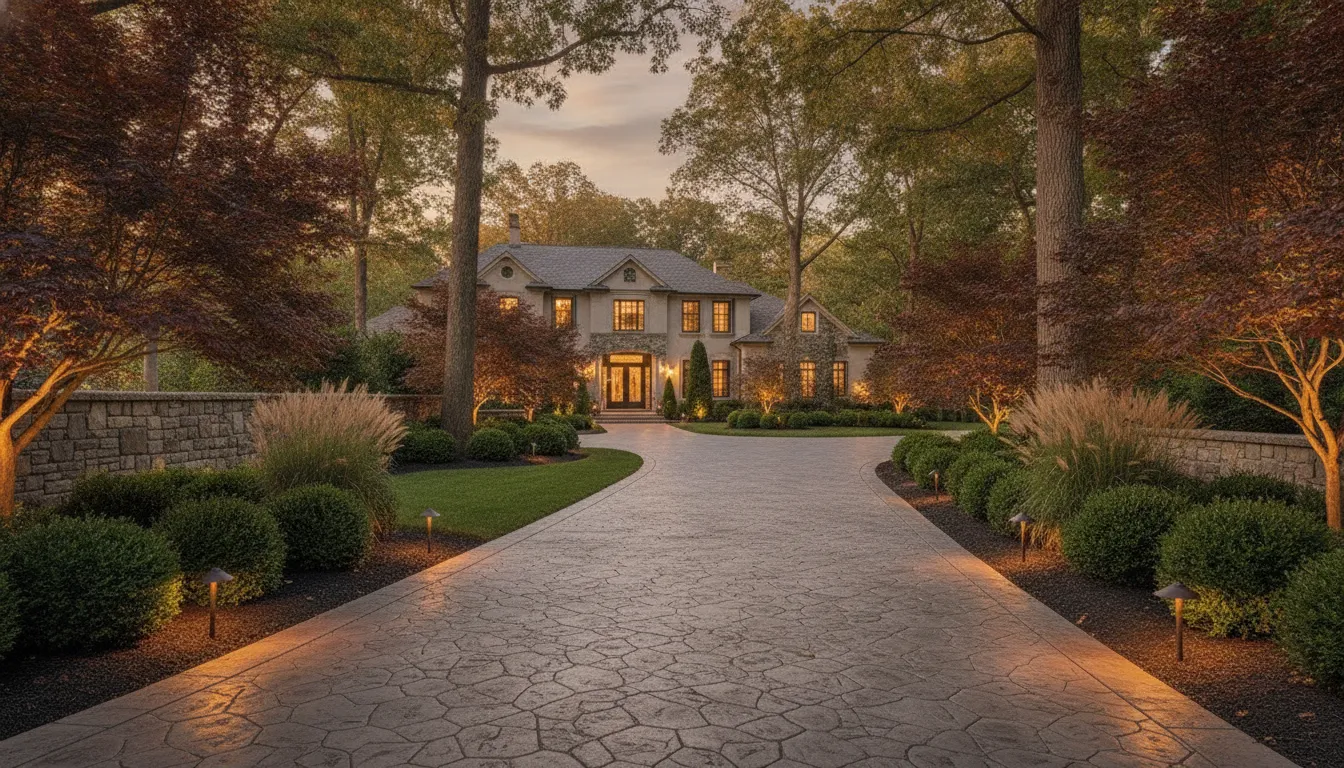
When homeowners ask, "How much does a stamped concrete driveway cost?" the most useful answer is not a single number. A driveway proposal depends on the area, surface design, base and drainage work, access, reinforcement, removal, and how the new drive connects to the home and landscape. This guide explains the cost variables to discuss before requesting a site-specific proposal in the Delaware Valley.
Schedule a driveway design conversation with DiSabatino.
What determines stamped concrete driveway cost?
Stamped concrete driveway cost is shaped by the complete scope, not only the decorative pattern. DiSabatino evaluates the driveway's dimensions, existing conditions, grading, drainage, concrete design, access, and relationship to the property before defining the work. A thoughtful scope separates the structural requirements from finish selections so the proposal can be compared accurately.
- Driveway size and geometry: More square footage affects material and labor, while curves, transitions, and multiple sections increase layout and forming work.
- Existing surface: Removal, disposal, repairs, or corrections to an old driveway can change the preparation scope.
- Base and soil conditions: Excavation, grading, aggregate base, and compaction help establish a stable foundation for the new surface.
- Drainage and slope: Water needs a deliberate path away from structures and toward appropriate collection or discharge areas.
- Concrete finish: Pattern, color, borders, joint layout, edge treatment, and sealer all affect the design and installation effort.
- Site access: The distance from delivery and staging areas to the work area can influence equipment, labor, and scheduling.
- Project coordination: Walls, steps, landscape beds, lighting, or other improvements may need to be sequenced with the driveway.
For a premium property, the driveway is not an isolated slab. It is part of the arrival experience. That is why DiSabatino's handcrafted hardscaping approach considers circulation, materials, grading, and adjacent landscape elements together.
Why can online driveway cost calculators be misleading?
Online calculators can help a homeowner organize questions, but they cannot see the property's grade, soil, access, existing surface, drainage, or architectural context. A calculator also may group very different finish levels under one label. Use an online estimate as a conversation starter, not as a local proposal or a substitute for site review.
Before treating a cost-per-square-foot figure as meaningful, ask whether it accounts for:
- Removal and disposal of the existing driveway.
- Excavation, aggregate base, compaction, and reinforcement.
- Drainage, grading, transitions, and protection of adjacent features.
- Pattern, color, border, joint, edge, and sealer selections.
- Delivery, staging, equipment access, cleanup, and restoration.
This distinction matters for Delaware Valley homeowners because a driveway proposal should respond to the actual property. DiSabatino's design-build team can help translate broad planning questions into a scope that reflects the home, landscape, and intended experience.
How does the size and layout of a driveway affect the proposal?
Size is an obvious part of the calculation, but layout is equally important. A simple rectangle and a broad, curved approach may have similar surface area while requiring different forming, control-joint, edging, and finishing plans. The entry, turnaround areas, garage alignment, and pedestrian connections should be reviewed together.
During planning, homeowners should identify:
- The preferred vehicle paths and turning movements.
- Where the driveway meets the public approach or existing paving.
- Whether the design needs a walkway, landing, step, or transition to another outdoor area.
- How snow, rainwater, and runoff will move across the site.
- Which trees, planting areas, walls, utilities, or structures must be protected.
Which finish choices change stamped concrete driveway cost?
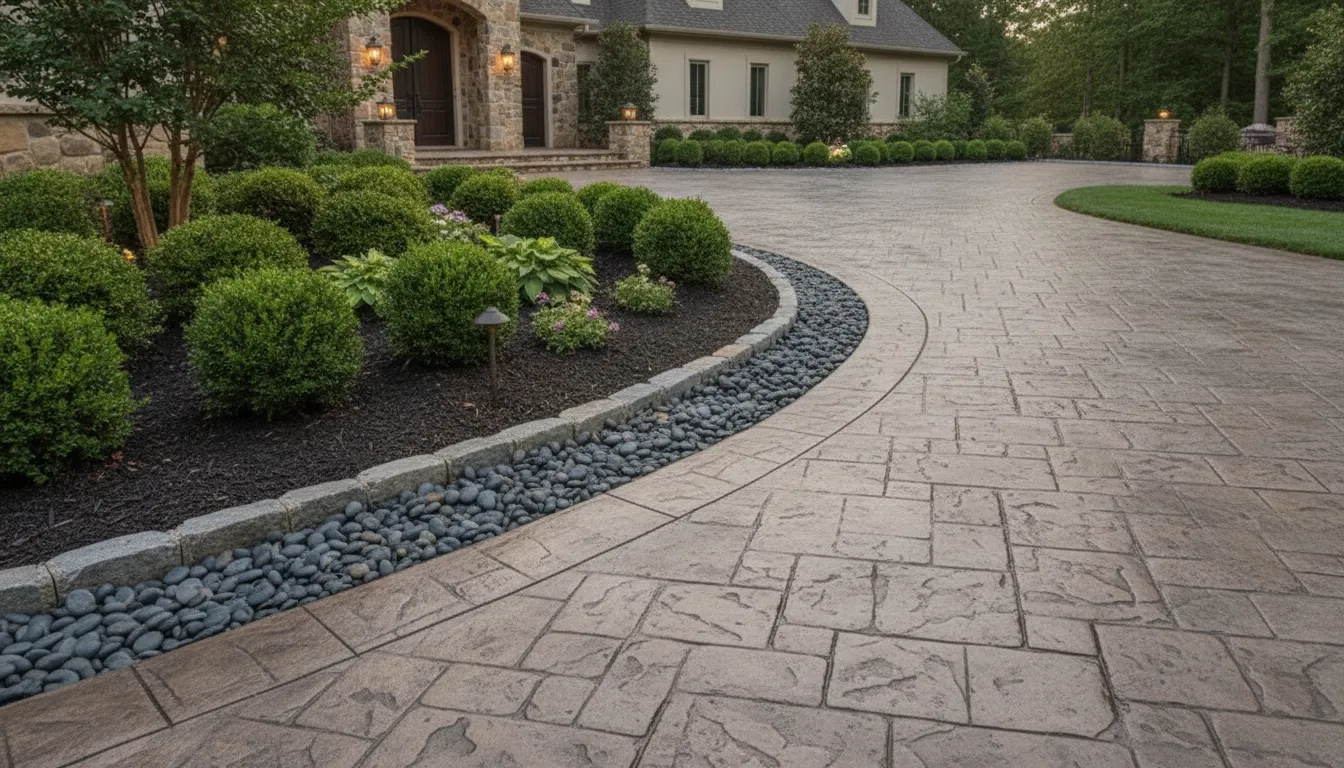
Decorative concrete is a coordinated finish system rather than a single material choice. The pattern, color approach, borders, texture, joint layout, edge details, and sealer should work together. A restrained design can complement a formal home, while a more expressive pattern may be appropriate for a relaxed outdoor setting. The right choice depends on the architecture and surrounding hardscape.
| Design decision | What to clarify | Why it matters |
|---|---|---|
| Pattern | Scale, direction, and relationship to the home | Sets the visual rhythm of the arrival area |
| Color | Base tone, accents, and compatibility with masonry | Connects the driveway to the exterior palette |
| Borders and edges | Contrast, bands, transitions, and edge restraint | Defines the shape and improves visual order |
| Control joints | Placement and alignment with the design | Balances performance needs with appearance |
| Sealer and care | Finish sheen, maintenance expectations, and renewal | Protects the appearance and sets long-term upkeep expectations |
Homeowners comparing proposals should confirm that each quote describes these details. A lower initial proposal may omit a border, a specific color process, final sealing, edge work, or preparation that another proposal includes. Comparing scope line by line is more useful than comparing a headline figure alone.
How do site preparation, drainage, and access affect the investment?
Site conditions are often the largest source of variation in stamped concrete driveway cost. A driveway may require excavation, removal, grading, base preparation, reinforcement, drainage improvements, or careful work around existing features. In the Delaware Valley, a site review should account for slope, runoff, freeze-thaw exposure, and how construction equipment can reach the work area.
Important planning questions include:
- Is the existing surface stable, or does it need to be removed?
- Does the current grade direct water toward a garage, foundation, or walkway?
- Will the driveway need a drain, swale, transition, or other drainage measure?
- Can trucks and equipment reach the placement area without damaging the property?
- Are walls, trees, utilities, or mature planting areas close to the work zone?
- Will the project require coordination with landscape installation or masonry?
DiSabatino's broader landscape and hardscape design-build services can help coordinate these relationships instead of treating drainage and grading as afterthoughts. The goal is a driveway that looks intentional and performs as part of the property.
Review DiSabatino's design-build process before planning your project.
Is stamped concrete a good fit for a high-end driveway?
Stamped concrete can be a strong fit when a homeowner wants a continuous surface with a tailored pattern and color rather than individual pavers. It can complement masonry, planting, lighting, and outdoor living features when the scale and finish are selected carefully. The best material depends on the home's architecture, site conditions, maintenance expectations, and desired visual character.
Consider stamped concrete when you value:
- A coordinated surface that can echo nearby stone or masonry.
- A custom pattern and color plan for the arrival sequence.
- Integration with walks, patios, steps, or landscape borders.
- A design-build team that can review drainage and surrounding site work together.
Other materials may be more appropriate when the project calls for individually replaceable units, a particular historic character, or a different maintenance strategy. DiSabatino can compare material directions through its hardscaping design services, with the final recommendation tied to the property rather than a generic material preference.
What should you ask before accepting a stamped concrete driveway proposal?
A useful proposal should make the scope understandable before construction begins. Ask the contractor to explain the base, thickness, reinforcement, removal, grading, drainage, concrete finish, joints, borders, sealer, access plan, schedule, and responsibilities for adjacent areas. Clear documentation reduces the chance that two proposals are being compared on different assumptions.
- Is the existing driveway removal and disposal included?
- What preparation and base work are included?
- How will drainage and transitions be handled?
- Which pattern, colors, borders, and edge details are included?
- How are control joints planned?
- Is final sealing included, and what future care is recommended?
- How will the team protect nearby planting, walls, and structures?
- Which related landscape or masonry work must be completed first?
A design-build conversation is especially useful when the driveway is part of a larger arrival, landscape, or outdoor living project. DiSabatino's architectural design services can help homeowners evaluate the driveway in relation to the complete property plan.
How can a homeowner get a project-specific answer?
The most reliable way to answer how much a stamped concrete driveway costs is to define the site and scope with a qualified design-build team. DiSabatino can review the property's dimensions, existing conditions, drainage, access, finish direction, and related hardscape needs before preparing a tailored conversation about the project.
Rather than relying on a generic online calculator, bring photos, approximate dimensions, examples of finishes you like, and any concerns about water, slope, access, or existing paving. Those details make the initial discussion more productive without treating a national estimate as a local proposal.
Contact DiSabatino to discuss a stamped concrete driveway for your Delaware Valley home.
Frequently Asked Questions
What is included in stamped concrete driveway cost?
The scope may include design, demolition, excavation, base preparation, reinforcement, concrete placement, color and pattern work, joints, borders, sealing, cleanup, and related drainage or grading. The included items should be listed clearly in the proposal.
Does driveway size determine the entire price?
No. Size affects material and labor, but layout, removal, soil and base conditions, slope, drainage, access, finish complexity, and coordination with adjacent work can change the proposal significantly.
Does stamped concrete require maintenance?
Yes. Homeowners should ask about cleaning, sealing, seasonal care, and how the selected finish should be maintained. A contractor should explain the care plan that fits the material and site.
Is stamped concrete better than pavers for every driveway?
No single driveway material is best for every property. Stamped concrete, pavers, and other hardscape options each have different design, maintenance, repair, and site-planning considerations.
Can stamped concrete be coordinated with landscaping?
Yes. Pattern scale, color, driveway edges, planting beds, lighting, walkways, walls, and drainage can be planned together so the arrival area feels connected to the rest of the property.